Borrowed Crowns
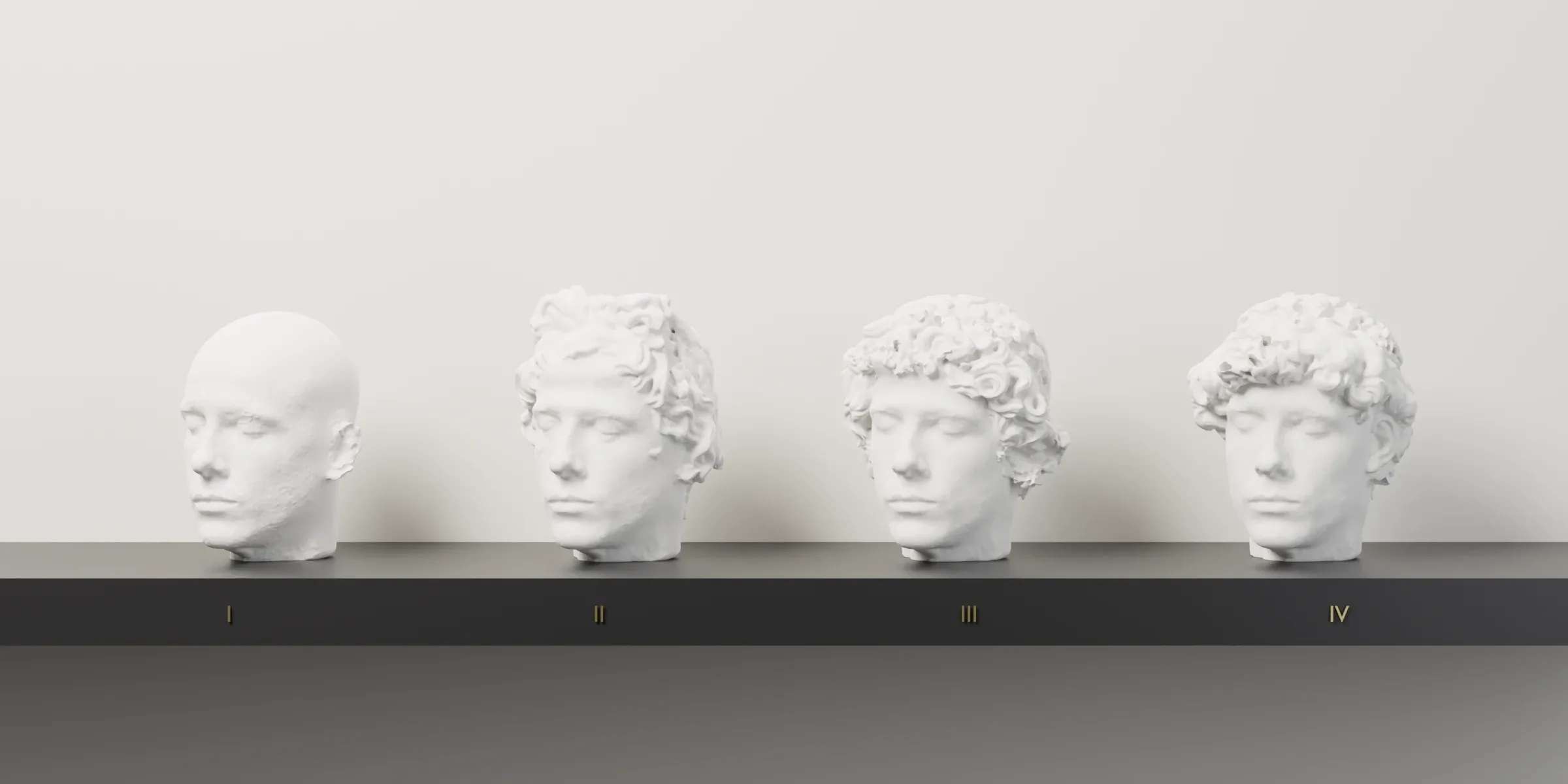
When my father died, I shaved my head. It is one of the oldest gestures of grief: you take something away so the loss can be seen. Then I had my head scanned. I wanted to hold that moment still, the bare skull and the face as grief had left it, in a form that would never grow back. I knew the work could not be finished then, because the tools to finish it did not exist yet. So the files waited.
Fourteen years later my hair is growing again, and this time it marks an arrival. These four busts hold both moments at once.
Fourteen years of files
The archive held four head scans. Only three were real captures. The 2012 scan, made with a structured-light scanner after the shave, is the root of everything. A 2014 scan followed, and a 2021 file that was labelled LiDAR turned out to be a phone app’s template head fitted to my face. A file from 2016 was the 2012 scan re-exported at a different scale. Two of the others were oversized by five to eight percent. None of them was closed, so none of them could be printed.
The fix was to wrap the 2021 template, which was complete but generic, onto the 2012 scan, which was faithful but full of holes, and remesh the two into one watertight shell. The face that came out is the 2012 face. Only the seams across the crown, where the scans were joined, were smoothed.
The crowns
There was no hair to scan. So the hair is borrowed. A survey of nine sculpted heads of gods and heroes came down to three:
- Apollo, from a plaster cast of the Apollo Belvedere, itself a Roman copy of a lost bronze. Light and healing, and a likeness the world loved after the original was gone.
- Helios, from a Hellenistic head of Alexander the Great as the sun god. A man made into the sun.
- David, Michelangelo’s, carved from a block other sculptors had abandoned. The piece about finishing.
In every version the face stays exactly as the scanner found it. The face is the record of the day of mourning, and changing it would rewrite the grief. The hair is fitted around it.
What it taught me
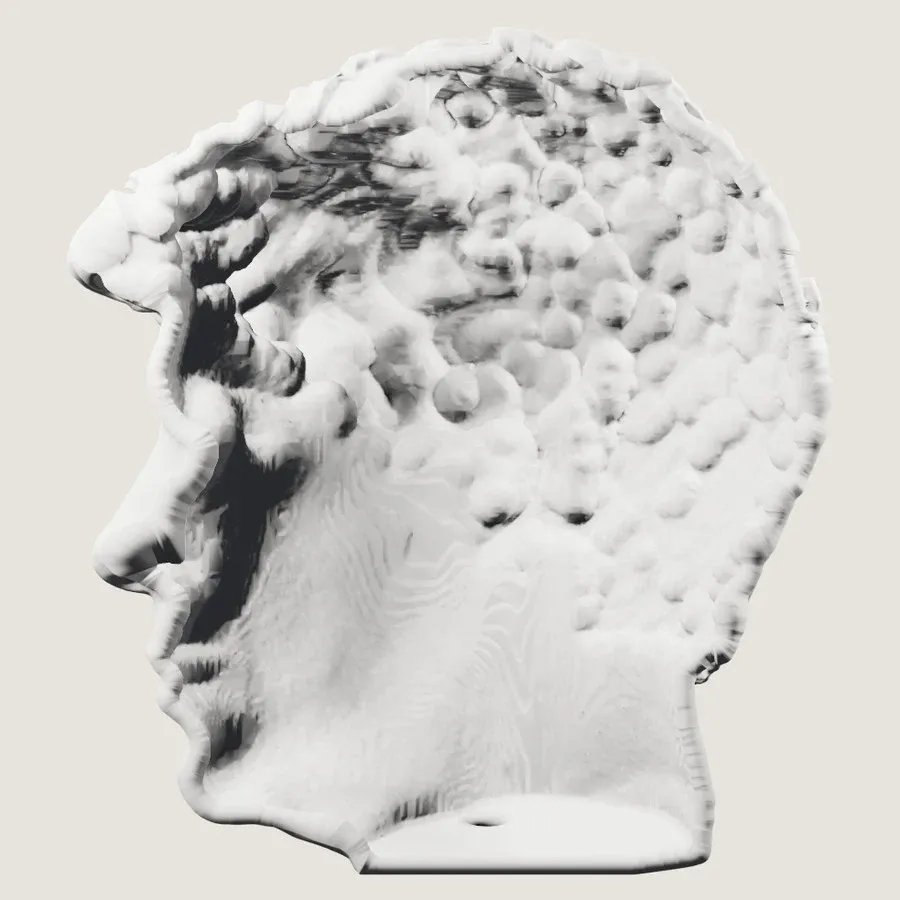
Each bust is printed at half size as a hollow shell three millimetres thick, in white nylon. The hollow started as a cost decision and became the meaning of the piece. The absence is still inside, and the triumph is what surrounds it.
The prints are on order for early December. This entry will get photographs of the real things when they arrive.